A Story That Begins With a Book
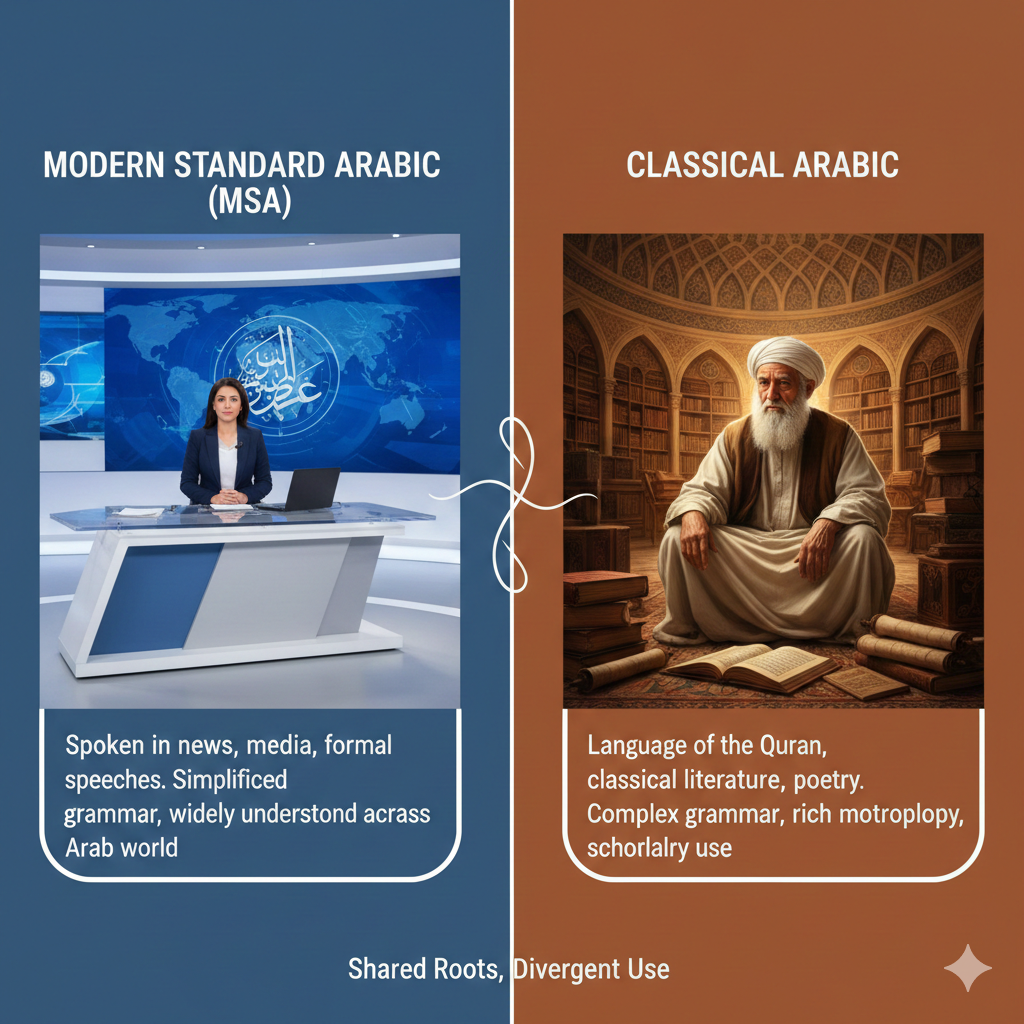
Imagine opening two books.
The first is a modern newspaper. The second is a centuries-old manuscript of the Qur'an. The letters look familiar. The grammar feels related. Yet the rhythm, tone, and purpose are unmistakably different.
This is where the story of Modern Standard Arabic (MSA) and Classical Arabic begins.
They are not two separate languages. They are two stages of the same language—shaped by time, culture, and need.
What Is Classical Arabic?
Classical Arabic is the Arabic of revelation, poetry, and early scholarship.
It reached its peak between the 6th and 9th centuries and was preserved through:
- The Qur'an
- Hadith literature
- Pre-Islamic and early Islamic poetry
- Classical theology, philosophy, and grammar texts
Classical Arabic is highly formal, structurally rich, and stylistically dense. Its vocabulary is vast, its syntax flexible, and its expressions often layered with metaphor and rhetorical devices.
It was designed for precision, beauty, and permanence.
What Is Modern Standard Arabic (MSA)?
Modern Standard Arabic is the Arabic of today's public life.
It emerged in the 19th and 20th centuries as the Arab world modernized and needed a shared written language for:
- Education
- Journalism
- Government
- Media
- Science and technology
MSA is based directly on Classical Arabic but simplified and standardized to meet modern communication needs.
It is used in:
- News broadcasts
- Books and articles
- Formal speeches
- Official documents
MSA is designed for clarity, efficiency, and accessibility.
The Core Difference, Told Simply
Think of Classical Arabic as an ancient, perfectly preserved city.
Think of MSA as that same city—expanded, renovated, and adapted for modern life.
The foundations are identical. The function is not.
Key Differences Between MSA and Classical Arabic
1. Vocabulary
Classical Arabic uses archaic and poetic terms rarely heard today.
MSA replaces many of these with modern words for politics, science, and technology.
Example: Classical Arabic may describe concepts abstractly or metaphorically. MSA names them directly.
2. Grammar and Structure
Classical Arabic allows complex sentence structures and flexible word order.
MSA prefers clearer, more direct constructions.
MSA avoids excessive grammatical intricacy to remain widely understandable.
3. Style and Tone
Classical Arabic is expressive, elevated, and rhetorical.
MSA is neutral, functional, and informational.
One aims to move the soul. The other aims to inform the public.
4. Usage Context
Classical Arabic is used in religious, literary, and historical texts.
MSA is used in formal, contemporary communication.
Neither is spoken naturally in daily conversation.
Are They Mutually Intelligible?
Yes.
Anyone fluent in MSA can understand Classical Arabic with study and exposure. Anyone trained in Classical Arabic can read MSA effortlessly.
The difference is register, not identity.
Why This Difference Matters
For learners, writers, and researchers, confusing MSA with Classical Arabic leads to frustration.
- Learning Classical Arabic alone will not prepare you for modern media.
- Learning only MSA will not unlock classical texts without additional study.
Understanding the distinction saves time, effort, and false expectations.
If your goal is to read the news, follow formal conversations and build a base for any dialect later, MSA is the place to start. Our complete Arabic video course teaches it step by step, from the alphabet to your first conversations. Not sure MSA is right for you? Read which Arabic you should learn first.
The Language That Refused to Break
Arabic is rare among world languages.
Instead of fragmenting into separate written forms, it preserved its classical core while building a modern layer on top.
MSA did not replace Classical Arabic. It grew out of it.
That continuity is why a reader today can still access texts written over a thousand years ago—something few languages can claim.
Final Thought
The difference between MSA and Classical Arabic is not a conflict. It is a timeline.
One tells the story of where Arabic came from. The other tells the story of how it lives today.
Same language. Different chapters.